
How to Read Tire Specs (2026): Decode Every Number on Your Sidewall
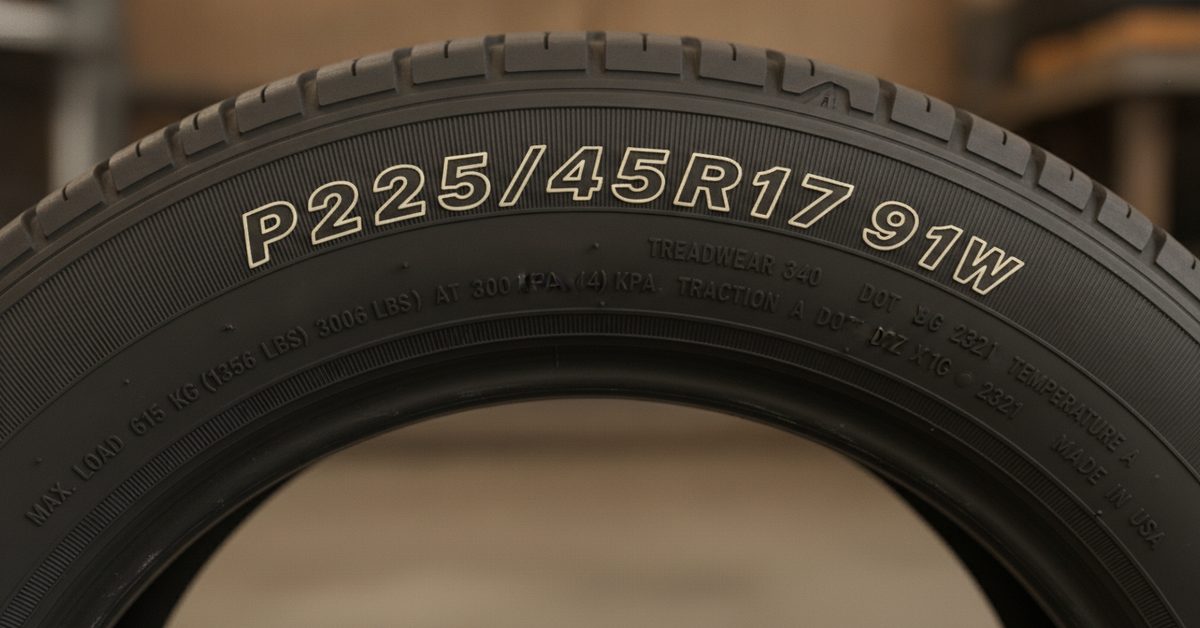
There's a wall of information on the sidewall of every tire you've ever owned. Most people ignore it completely — they buy tires based on the number their mechanic tells them, mount them, and drive away.
That's fine until you're trying to verify a fitment, compare two tires, or figure out why your fuel economy dropped after a tire swap. Then you need to know what those numbers actually mean.
Here's the complete breakdown of everything printed on a tire sidewall, with Canadian context where it matters.
The Main Size Code: What 225/65R17 102H Actually Means
Let's break down the most common tire size format using a real example: 225/65R17 102H
225 — Section Width (mm)
This is the width of the tire measured from sidewall to sidewall when mounted on a properly sized rim, expressed in millimetres. So 225 means the tire is 225 mm (about 8.9 inches) wide.
Wider tires have more contact patch on dry pavement — better dry grip. Narrower tires cut through snow and slush more effectively — better winter grip. This is why downsizing winter wheels to a narrower tire is a legitimate performance technique for Canadian winters.
For a deeper look at how section width affects performance, see the tire section width guide.
65 — Aspect Ratio (%)
The aspect ratio is the sidewall height expressed as a percentage of the section width. A 225/65 tire has a sidewall height of 65% of 225 mm = 146 mm (about 5.7 inches).
Lower aspect ratio = lower profile = less sidewall height = sportier handling, but more vulnerability to pothole damage. A 225/35R19 tire (the kind on a BMW M car) has a sidewall height of only 79 mm — barely over 3 inches.
For Ontario roads with their pothole problem, extremely low-profile tires require more care. High-profile tires (65, 70, 75 series) absorb impacts better — relevant for winter setups.
Read more in the tire aspect ratio guide.
R — Construction Type
"R" stands for Radial construction — the virtually universal standard for modern passenger car, SUV, and truck tires. Radial means the internal cords run perpendicular (radially) to the direction of travel, with belts underneath the tread.
Occasionally you'll see "D" for diagonal/bias-ply construction, which is mostly found on vintage vehicles, trailers, and some agricultural applications.
17 — Rim Diameter (inches)
The diameter of the wheel the tire is designed to fit, in inches. A 225/65R17 fits a 17-inch rim. This must match your wheel exactly — a 17" tire won't fit on an 18" rim.
102 — Load Index
This is the maximum weight the tire can support at maximum inflation. Load index 102 = 850 kg per tire.
This is not the same as load range (the letter designation on LT tires). Load index is a number from 71 to 121+ for passenger tires, each corresponding to a specific weight in kilograms.
For the complete load index chart and what it means for Canadian truck and SUV drivers, see the tire load ratings guide.
H — Speed Rating
The speed rating tells you the maximum sustained speed the tire is certified for. The most common ratings:
| Speed Rating | Max Speed | Typical Use |
|---|---|---|
| S | 180 km/h | Spare tires, basic passenger cars |
| T | 190 km/h | Standard passenger cars |
| H | 210 km/h | Sport sedans, SUVs |
| V | 240 km/h | Performance cars |
| W | 270 km/h | High-performance sports cars |
| Y | 300 km/h | Ultra-high-performance |
In Canada, the speed rating also correlates with tire construction quality. V and W-rated tires have stiffer sidewalls and higher-quality compounds that perform better dynamically.
Important: Never install a tire with a lower speed rating than your vehicle's OEM specification. If your car came with H-rated tires, going to T-rated tires for "budget" reasons is technically a downgrade in the tire's engineering standard.
On XL tires, the speed rating interacts with the extra load designation — check that post for detail.
Additional Sidewall Markings
P vs. LT Prefix
- P (P-metric): Passenger car tire, designed for cars and light SUVs
- LT (Light Truck): Designed for pickup trucks, heavy SUVs, and commercial vans — built to handle greater loads
Some tires have no prefix (metric or European metric sizing). These follow slightly different load calculation rules than P-metric tires.
For SUV and truck owners: if your vehicle's OEM specification calls for an LT-spec tire, installing a P-metric is an under-spec. The vehicle is heavier than what a P-metric is rated for. This is especially important for trucks that tow.
XL or "Extra Load" Marking
XL (or Reinforced) tires have a higher load capacity than standard tires of the same size. They're inflated to higher pressures (typically 42–51 PSI vs. 32–36 PSI for standard) to achieve that extra load capacity.
XL tires are increasingly common as OEM fitments on European vehicles. If your car came with XL tires, replace with XL tires — using a standard tire at standard pressure will under-rate your load capacity.
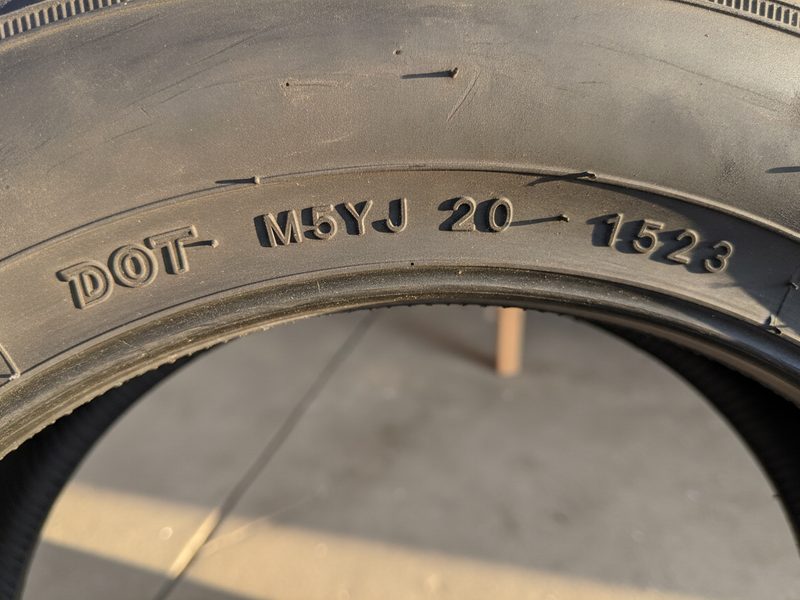
The DOT Code
The DOT code begins with "DOT" followed by a series of letters and numbers, ending with a 4-digit date code. The last four digits are the most important: they tell you when the tire was manufactured.
Reading the date code: The format is WWYY — week number and year. A code of "2323" means the 23rd week of 2023.
Tires older than 6 years should be inspected carefully regardless of tread depth. At 10 years, they should be replaced regardless of condition. Rubber degrades from the inside even when tread looks fine. For the full breakdown, see the tire date code guide.
M+S (Mud and Snow)
The M+S marking indicates the tire has been designed for mud and light snow use. This is a relatively low bar — it means the tread pattern and compound can handle moderate winter conditions.
Note: M+S is NOT the same as the 3PMSF (Three-Peak Mountain Snowflake) certification, which requires actual winter traction testing. Many all-season tires carry M+S but not 3PMSF.
The Snowflake Symbol (3PMSF)
Three-Peak Mountain Snowflake — a mountain symbol with a snowflake inside — indicates the tire has passed winter traction testing and is certified for severe winter conditions. This is the meaningful winter certification.
Dedicated winter tires always carry this symbol. Better all-weather tires also carry it. Standard all-season tires typically do not.
The UTQG Ratings
UTQG (Uniform Tire Quality Grading) is a US DOT system that provides three standardized ratings, printed on the sidewall.
Treadwear Rating
A number where 100 is the baseline. A treadwear rating of 400 means the tire should last approximately 4x as long as the reference tire. Higher is longer-lasting.
Practical context:
- 200–299: Performance summer tires with short tread life
- 300–499: Mid-range all-season, performance tires
- 500–700+: Touring and commuter all-seasons with long tread life
This is useful for comparison but not a precise kilometre prediction — your actual tread life depends on inflation, alignment, driving style, and road conditions.
Traction Rating
AA, A, B, or C — measuring the tire's ability to stop on wet pavement in a standardized test.
- AA: Best wet traction (highest)
- A: Good wet traction — minimum recommended for highway use
- B: Acceptable
- C: Poor wet traction — avoid
Most quality tires are rated A or AA. Anything rated B or lower in wet traction is a flag.
For detail on what these ratings mean in practice, see the tire traction rating guide.
Temperature Rating
A, B, or C — the tire's resistance to heat buildup at high speed.
- A: Best (rated for over 185 km/h sustained)
- B: Good (up to 185 km/h)
- C: Minimum (up to 160 km/h)
All highway tires should be A-rated. A C-rated tire is not suitable for sustained 400-series highway driving in Ontario.
Metric vs. Flotation Sizing for Trucks and SUVs
Most passenger cars and crossovers use the standard metric format (225/65R17). Trucks and off-road vehicles sometimes use flotation sizing — a format that looks like 35x12.50R17.
Reading flotation sizing:
- 35: Overall tire diameter in inches
- 12.50: Section width in inches
- R: Radial construction
- 17: Rim diameter in inches
So a 35x12.50R17 is a 35-inch diameter tire, 12.5 inches wide, for a 17-inch rim.
These two sizing systems measure the same thing differently. For size conversion between the two, see the SAE to metric tire size conversion guide.
Common Mistakes When Reading Tire Sizes
Upsizing Without Checking
People upsize tires all the time — going from a 225/65R17 to a 235/65R17 for a slightly wider stance. This is usually fine but requires checking:
- Will the tire fit inside the wheel well? Wider tires can rub on fenders and suspension components.
- Does the overall diameter change? Changing aspect ratio and width simultaneously can change the overall rolling diameter, affecting speedometer accuracy.
- Is the load index still sufficient? Going wider doesn't automatically mean higher load capacity.
- Wheel width compatibility: A tire that's too wide for the rim causes bulging; too narrow causes instability.
Confusing P-Metric and LT Load Calculations
When comparing P-metric and LT tire load ratings, they're not directly comparable. An LT tire must be derated by 10% of its rating when used on a passenger application. Conversely, a P-metric tire on a truck application is being pushed beyond its design intent.
Ignoring Speed Rating on Replacement
If your vehicle came with V-rated (240 km/h) tires and you install T-rated (190 km/h) replacements, you've technically downgraded your tire engineering. The lower rating isn't just about speed — it reflects construction quality differences.
Where to Find Your Correct Tire Size
Your correct tire size is in three places:
- Door placard: Inside the driver's door jamb — shows OEM size and recommended inflation pressure
- Owner's manual: Lists approved tire sizes by trim level
- Glove box or fuel door: Some manufacturers place size stickers here as well
The door placard is the authoritative source. If a tire shop recommends something different from the door placard, ask why — there's sometimes a valid reason (load rating upgrade, seasonal application), but you should understand the reason.
Brian Barber
Automotive experts at Autrex providing in-depth guides on tires, wheels, and vehicle maintenance to help you make informed decisions.
Related Articles
Winter Tires in Québec 2026: Law, Dates and Buyer's Guide
Québec winter tire law for 2026: mandatory December 1 to March 15, the 3PMSF symbol, studded vs studless, sizing and when to install. Plus in-stock winter tires.
Fall Tire Prep in Canada (2026): When to Get Winter Tires Ready
Fall tire prep guide: when to book winter tire appointments, inspect stored tires, and plan your budget. Get ahead before the October rush.

Summer Car Prep Checklist (2026): Post-Winter Tires, Brakes & Suspension
Summer car prep checklist: post-winter tire inspection, brake check, suspension inspection, and road trip readiness for Canadian drivers.