
Wheel Fitment Guide (2026): Bolt Pattern, Offset & Hub Bore Explained
Buying aftermarket wheels should be straightforward. It's not. There are four critical measurements that must be right, and getting any one of them wrong means a wheel that either doesn't mount, creates vibration, rubs on suspension components, or — worst case — isn't safe.
Here's the complete guide to getting wheel fitment right the first time.
The Four Numbers That Matter
1. Bolt Pattern
The bolt pattern is the number of lug holes and the diameter of the circle they form. Expressed as "5x114.3" — five lug holes on a 114.3 mm diameter circle.
Common Canadian vehicle bolt patterns:
| Bolt Pattern | Common Vehicles |
|---|---|
| 5x100 | Subaru, VW, Toyota (some) |
| 5x10⁸ | Ford (European models), Volvo |
| 5x112 | VW, Audi, Mercedes-Benz |
| 5x114.3 | Honda, Toyota, Nissan, Hyundai, Ford (some) |
| 5x120 | BMW, newer Honda, GM (some) |
| 5x127 | Jeep Wrangler/Gladiator |
| 6x135 | Ford F-150 |
| 6x139.7 | GM trucks, Toyota trucks, RAM |
Your bolt pattern must match exactly. A wheel with a 5x112 bolt pattern will not fit a vehicle with 5x114.3 — even though the difference is only 2.3 mm.
For a deeper dive: bolt pattern fitment guide and how to measure bolt patterns.
Some wheels use a dual bolt pattern to fit multiple vehicles — useful when you want versatility.
2. Offset
Offset is the distance (in millimetres) between the wheel's mounting surface and its centerline. It determines how far in or out the wheel sits relative to the fender.
- Positive offset (+45): The mounting surface is toward the outside of the wheel. The wheel sits further inward. Common on front-wheel-drive cars.
- Zero offset (0): The mounting surface is at the centerline.
- Negative offset (-12): The mounting surface is toward the inside. The wheel sticks out past the fender. Common on lifted trucks.
Why offset matters:
The wrong offset creates real problems:
- Too much positive offset: The tire may rub on suspension components or inner fender liners
- Too much negative offset: The tire sticks out past the fender, creating spray issues, potential legality problems, and additional stress on wheel bearings
- Even 10 mm off can cause rubbing under full compression or at full steering lock
For the complete guide: wheel offset guide.
3. Center Bore (Hub Bore)
The center bore is the hole in the middle of the wheel that fits over the hub. It must match your vehicle's hub diameter for a hub-centric fit.
Hub-centric: The wheel centres on the hub, not the lug nuts. This is the proper and safe way to mount a wheel. It ensures the wheel is perfectly centred and reduces vibration.
Lug-centric: If the wheel's center bore is larger than the vehicle's hub, it centres on the tapered lug nuts instead. This works, but it's less precise and more prone to vibration.
Hub-centric rings solve the mismatch — they fill the gap between a larger wheel bore and a smaller hub. They're inexpensive ($10–$20 for a set of four) and essential for a vibration-free ride.
4. Width
Wheel width (measured in inches) determines which tire sizes can be mounted. A wheel that's too narrow for the tire causes bulging; too wide causes the tire to stretch.
Each tire size has a range of acceptable wheel widths:
| Tire Width | Minimum Wheel Width | Ideal Wheel Width | Maximum Wheel Width |
|---|---|---|---|
| 205 mm | 6.0" | 6.5" | 7.5" |
| 225 mm | 7.0" | 7.5" | 8.0" |
| 245 mm | 7.5" | 8.0" | 8.5" |
| 265 mm | 8.0" | 8.5" | 9.5" |
| 285 mm | 9.0" | 9.5" | 10.5" |
Going outside these ranges creates safety concerns. Tire stretch (mounting a narrow tire on a wide wheel) looks aggressive but reduces sidewall support and increases the risk of tire bead separation.
How to Use a Fitment Calculator
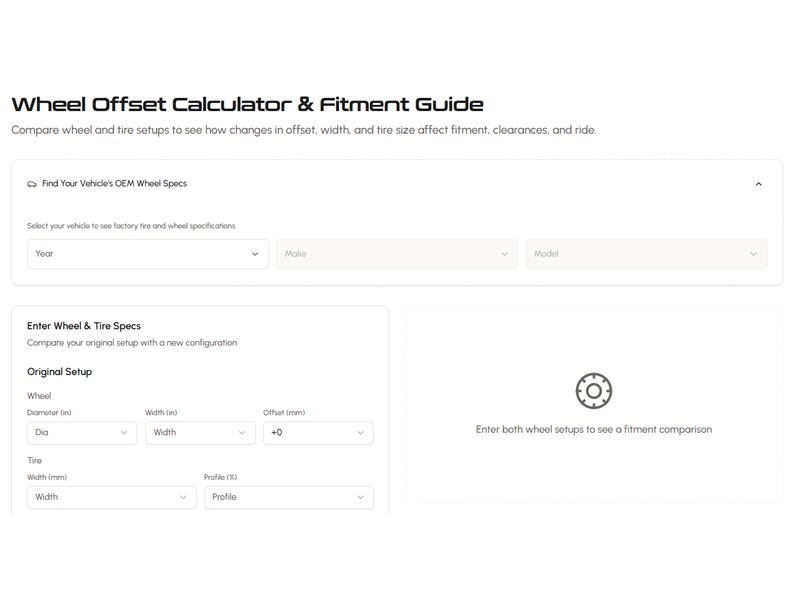
A fitment calculator takes your vehicle information (year, make, model, trim) and outputs the acceptable wheel specifications:
- Bolt pattern
- Acceptable offset range
- Hub bore diameter
- Maximum wheel width
Autrex's fitment tool (available at launch) will verify compatibility before purchase — enter your vehicle, and it confirms whether a specific wheel fits.
Common Fitment Mistakes
Wrong Offset Causing Tire Rub
This is the most common error. Someone buys wheels with a lower offset for a more aggressive stance, then discovers the tires rub on the fender liner or suspension at full lock or over bumps.
Prevention: Stay within 10 mm of your OEM offset for safe fitment. Beyond that, verify clearance with test-fitting or use a fitment gallery showing the same wheel on the same vehicle.
Wrong Bolt Pattern Stripping Lugs
Attempting to mount a wheel with a slightly different bolt pattern (e.g., 5x112 on 5x114.3) can appear to fit initially but creates stress on the lug studs. Over time, this can strip threads or cause wheel wobble.
Prevention: Verify bolt pattern with a ruler, bolt pattern gauge, or by counting lugs and measuring the bolt circle diameter.
Ignoring Center Bore
Mounting a wheel without hub-centric rings when the bore doesn't match creates vibration. The wheel is slightly off-center, and the imbalance manifests as a shimmy at highway speed that no amount of wheel balancing will fix.
Prevention: Always verify center bore and use hub-centric rings if there's any mismatch.
Not Checking Brake Clearance
Aftermarket wheels may not clear your brake calipers — especially if you have upgraded brakes. The spoke design and inner clearance pocket must accommodate the caliper.
Prevention: Check the wheel's backspacing (distance from the mounting surface to the inside lip) against your caliper dimensions. Many wheel manufacturers publish caliper clearance specs.
Krypton Wheels Fitment
Krypton wheels — Autrex's private-label alloy wheel line — are designed with the most common Canadian vehicle fitments in mind. Hub-centric rings are included where needed, and fitment verification is available through our online tool.
The Krypton lineup covers the most popular bolt patterns: 5x114.3 (Honda, Toyota, Nissan), 5x120 (BMW, newer GM), 6x135 (Ford trucks), and 6x139.7 (GM/RAM/Toyota trucks).
The Bottom Line
Wheel fitment isn't guesswork. Four measurements — bolt pattern, offset, center bore, and width — determine whether a wheel fits safely and correctly.
Get them right, and your aftermarket wheels will look great and perform flawlessly. Get them wrong, and you're dealing with vibration, rubbing, uneven wear, or worse.
Measure twice, buy once.
Final Thoughts: Measure Twice, Buy Once
Wheel fitment errors are expensive. A wheel that doesn't fit your vehicle creates vibration, rubbing, alignment problems, or worse. Take the time to verify all four measurements — bolt pattern, offset, center bore, and width — before ordering.
If you're unsure about any spec, check your door placard, consult a fitment guide, or reach out to a knowledgeable source. The 10 minutes spent verifying fitment saves hours of hassle later.
For Canadian vehicles, Krypton wheels are designed with common bolt patterns and include hub-centric rings where needed. But the principle applies to any wheel purchase: verify before you buy.
Brian Barber
Automotive experts at Autrex providing in-depth guides on tires, wheels, and vehicle maintenance to help you make informed decisions.
Related Articles

What Makes a Wheel Winter-Approved? Certification, Finishes and Fitment
There is no official winter certification for wheels in Canada. Here is what 'winter approved' really means, which finishes survive road salt, and how to choose winter wheels.
Are Steel Wheels Best for Winter? A Complete Guide
Find out why steel wheels are the top choice for winter driving — durability, cost savings, corrosion resistance, and better traction in snow and ice.

Do Steel Rims Last Longer?
Do Steel Rims Last Longer? - Complete guide from Autrex, Canada's trusted auto parts source.