
El offset de los rines explicado: guía para principiantes para lograr el ajuste perfecto

Si vas a mejorar los rines de tu vehículo, entender el offset del rin es tan importante como conocer tu patrón de pernos. Un offset incorrecto puede causar roce, mal manejo, desgaste prematuro e incluso problemas de seguridad. Esta guía desglosa todo lo que necesitas saber.
¿Qué es el offset del rin?
El offset del rin es la distancia (en milímetros) entre la línea central del rin y la superficie de montaje del rin (donde el rin se atornilla al cubo).
Normalmente está marcado en el rin como ET seguido de un número (de la palabra alemana Einpresstiefe, que significa "profundidad de inserción"). Por ejemplo, ET45 significa un offset de +45 mm.
Los tres tipos de offset
Offset positivo (el más común)
La superficie de montaje está hacia la cara delantera del rin (lado de la calle). Esto empuja el rin hacia adentro, hacia la suspensión.
- Valores comunes: +35 a +55 mm
- Usado en: la mayoría de los vehículos de pasajeros modernos, SUV
- Ejemplos: Toyota Camry (
+45), Honda Civic (+45), VW Golf (~+45)
Offset negativo
La superficie de montaje está hacia atrás del rin (interior). Esto empuja el rin hacia afuera del vehículo.
- Valores comunes: -10 a -25 mm
- Usado en: rines de plato profundo, camionetas elevadas, montajes todoterreno
- Efecto: vía más ancha, los rines sobresalen de las salpicaderas
Offset cero
La superficie de montaje está exactamente en la línea central del rin.
- Común en: algunos autos clásicos y remolques
- Efecto: posicionamiento neutral
¿Por qué importa el offset del rin?
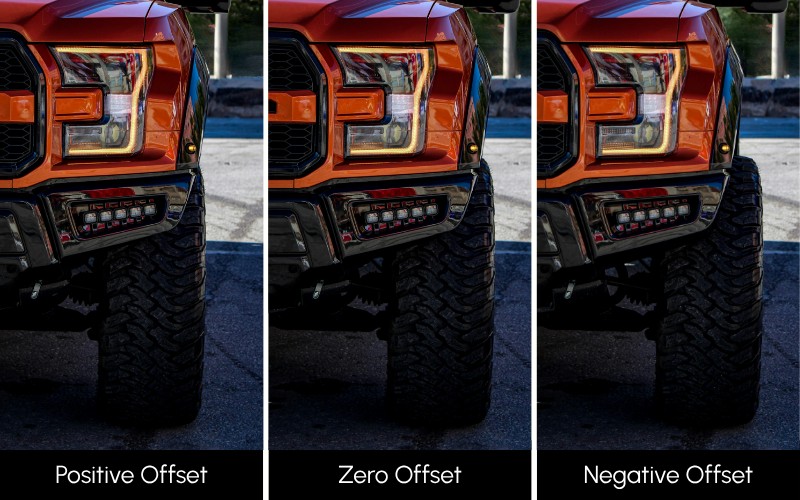
Equivocarse con el offset puede causar problemas serios:
| Demasiado offset positivo | Demasiado offset negativo |
|---|---|
| Rines metidos demasiado hacia adentro | Rines que sobresalen de las salpicaderas |
| Roce en la salpicadera interior | Roce en la salpicadera exterior |
| Estrés en los componentes de la suspensión | Mayor esfuerzo de dirección |
| Vía reducida | Desgaste acelerado de los rodamientos del rin |
| Problemas de espacio con los frenos | Posibles problemas de legalidad |
Una diferencia de apenas 5-10 mm respecto al offset recomendado de tu vehículo puede causar cambios notables en el manejo. Mantente siempre dentro del rango recomendado por el fabricante o consulta a un especialista en rines.
Offsets de fábrica comunes por tipo de vehículo
| Tipo de vehículo | Rango de offset típico |
|---|---|
| Autos compactos (Civic, Corolla) | +40 a +50 mm |
| Sedanes medianos (Camry, Accord) | +38 a +50 mm |
| Autos deportivos (Mustang, 86) | +35 a +48 mm |
| SUV (RAV4, CR-V, Tiguan) | +35 a +50 mm |
| Camionetas (F-150, Silverado) | +15 a +35 mm |
| Camionetas elevadas y todoterreno | -25 a +15 mm |
Cómo medir el offset del rin
Puedes medir el offset en casa con una regla recta y una cinta métrica:
Paso 1: Mide el ancho total del rin
Coloca el rin boca abajo. Pon una regla recta sobre el borde trasero. Mide la distancia total desde la superficie de montaje hasta la regla recta. Llámalo A.
Paso 2: Encuentra la línea central
Mide el ancho total del barril del rin (del borde interior al borde exterior). Divide entre 2. Esta es tu distancia de línea central.
Paso 3: Calcula el offset
Offset = A − distancia de línea central
- Si el resultado es positivo → offset positivo
- Si el resultado es negativo → offset negativo
- Si el resultado es cero → offset cero
¿No quieres hacer los cálculos? Usa nuestra calculadora de offset de rines: solo ingresa las especificaciones de tu rin actual y el deseado, y te mostraremos exactamente cómo cambia el ajuste.
Offset vs. backspacing
Estos términos están relacionados pero son diferentes:
- Offset = distancia desde la línea central hasta la superficie de montaje
- Backspacing = distancia desde el borde trasero del rin hasta la superficie de montaje
Conversión entre ambos:
Backspacing = (Wheel Width / 2) + Offset
Offset = Backspacing - (Wheel Width / 2)
Ejemplo: un rin de 9" de ancho (228,6 mm) con offset de +35 mm tiene:
Backspacing = (228.6 / 2) + 35 = 149.3mm = ~5.88"
¿Qué pasa si cambio el offset?
Pasar a un offset más bajo (p. ej. +45 → +35)
- Los rines se mueven hacia afuera 10 mm por lado
- Vía más ancha
- Puede requerir modificaciones en las salpicaderas
- Verifica el espacio de la salpicadera exterior
Pasar a un offset más alto (p. ej. +35 → +45)
- Los rines se mueven hacia adentro 10 mm por lado
- Vía más estrecha
- Puede rozar la salpicadera interior o la suspensión
- Verifica el espacio del cáliper
Regla general: mantente dentro de ±10 mm de tu offset de fábrica para un ajuste sin problemas.
Separadores de rin: una alternativa a los cambios de offset
Si te encanta un juego de rines pero el offset no es del todo correcto, los separadores de rin pueden ayudar:
- Separadores de 5 mm: cambio sutil, efecto visual mínimo
- Separadores de 10-15 mm: vía notablemente más ancha
- Separadores de 20 mm o más: cambio significativo, puede requerir birlos más largos
Usa siempre separadores centrados en el cubo con birlos extendidos adecuados o separadores atornillados. Los separadores sueltos o genéricos son peligrosos. Los separadores baratos nunca valen el riesgo.
Interacción entre el offset y el tamaño del neumático
Cuando cambias el ancho del rin, normalmente necesitas ajustar el offset para mantener el mismo ajuste:
- Pasar a un rin más ancho (p. ej. 7,5" → 8,5") manteniendo el mismo offset significa que el rin crece en ambas direcciones: 12,7 mm hacia adentro Y 12,7 mm hacia afuera
- Para mantener el borde exterior en la misma posición, aumenta el offset en ~12,7 mm
- Para mantener el borde interior en la misma posición, disminuye el offset en ~12,7 mm
Preguntas frecuentes
¿Qué offset necesito para un ajuste a ras (flush)?
Esto depende de tu vehículo, la forma de las salpicaderas y la configuración de la suspensión. Por lo general, un offset de 5 a 15 mm más bajo que el de serie, combinado con un rin ligeramente más ancho y un tamaño de neumático adecuado, da un look a ras sin roce.
¿Un offset incorrecto puede dañar mi auto?
Sí. Un offset negativo excesivo somete a mayor estrés a los rodamientos del rin, las rótulas y las terminales de dirección. Un offset positivo excesivo puede causar problemas de espacio con los frenos y daños en la salpicadera interior.
¿ET es lo mismo que offset?
Sí. ET (Einpresstiefe) es la denominación europea del offset del rin. ET45 = offset de +45 mm.
¿Necesito tuercas nuevas al cambiar el offset?
No específicamente por los cambios de offset, pero si cambias de marca de rin, verifica el tipo de asiento de la tuerca (cónico, esférico o plano).
Logra el ajuste correcto
Cada rin que vendemos en Autrex incluye especificaciones detalladas de offset. Usa nuestra herramienta de ajuste por vehículo para encontrar rines con el offset perfecto para tu auto, sin adivinanzas.
Explorar rines por vehículo → | Calculadora de offset de rines →
Autrex
Automotive experts at Autrex providing in-depth guides on tires, wheels, and vehicle maintenance to help you make informed decisions.
Related Articles
Guía de ajuste de rines (2026): patrón de pernos, offset y barreno central explicados
Guía de ajuste de rines: patrón de pernos, offset, barreno central y ancho explicados. Cómo comprar rines de repuesto que ajusten de forma segura a la primera.

¿Son los rines de acero la mejor opción para el invierno? Guía completa
Descubre por qué los rines de acero son la mejor opción para conducir en invierno: durabilidad, ahorro de costos, resistencia a la corrosión y mejor tracción en nieve y hielo.

¿Duran más los rines de acero?
¿Duran más los rines de acero? - Guía completa de Autrex, la fuente de autopartes de confianza en Canadá.