
What Is a Clutch Slave Cylinder? Purpose, Symptoms & Replacement

In the world of manual transmissions, the clutch slave cylinder is an essential hydraulic component that makes smooth gear changes possible. Working behind the scenes every time you press the clutch pedal, this relatively simple part plays a critical role in your vehicle's drivability. Understanding how it works, recognizing failure symptoms, and knowing when to replace it can save you from being stranded with a transmission that won't shift.
What Is a Clutch Slave Cylinder?
The clutch slave cylinder is a hydraulic actuator that's part of the hydraulic clutch system found in most modern manual transmission vehicles. It works in partnership with the clutch master cylinder to disengage the clutch when you press the clutch pedal.
In older vehicles, the clutch was operated by a mechanical linkage (cable or rod). Modern vehicles replaced this with a hydraulic system — similar to how hydraulic brakes work — because it provides smoother, more consistent clutch feel with less pedal effort.
Where Is It Located?
The slave cylinder is mounted on or near the transmission bell housing, close to the clutch fork or release bearing. There are two main types:
- External slave cylinder — Bolted to the outside of the bell housing, connected to the clutch fork via a pushrod. Easier to access and replace.
- Concentric slave cylinder (CSC) — Mounted inside the bell housing, surrounding the transmission input shaft. Acts as both the slave cylinder and release bearing. Requires transmission removal to replace.
How Does the Clutch Slave Cylinder Work?
The hydraulic clutch system operates in a straightforward sequence:
- You press the clutch pedal — This pushes the piston inside the clutch master cylinder, pressurizing hydraulic fluid in the system.
- Fluid travels through the line — Pressurized brake fluid (DOT 3 or DOT 4) flows through a hydraulic line from the master cylinder to the slave cylinder.
- Slave cylinder actuates — The hydraulic pressure pushes the slave cylinder's piston outward.
- Clutch disengages — The piston pushes the clutch fork (external type) or directly contacts the pressure plate diaphragm spring (concentric type), releasing the clutch disc from the flywheel.
- You shift gears — With the clutch disengaged, the transmission input shaft spins freely, allowing gear changes.
- You release the pedal — A return spring in the pressure plate pushes everything back, and the slave cylinder piston retracts. The clutch re-engages.
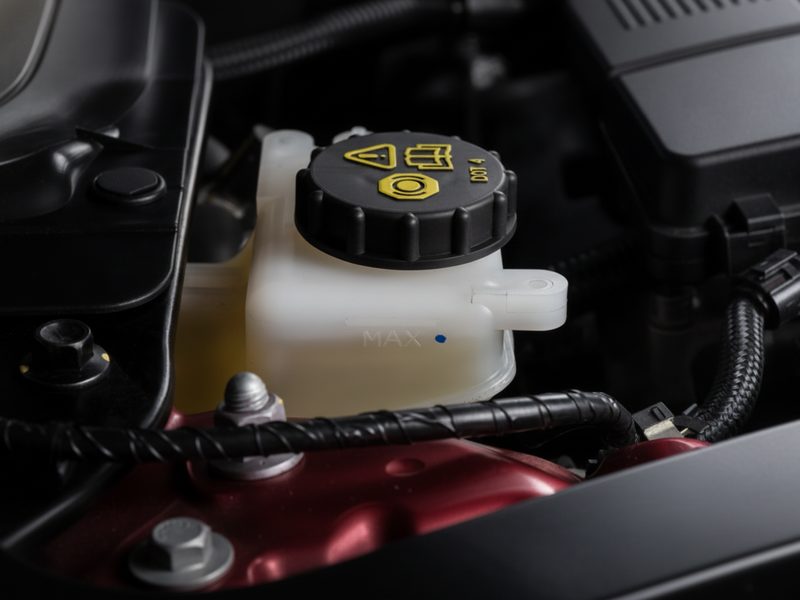
The clutch hydraulic system uses the same type of fluid as your brakes — typically DOT 3 or DOT 4 brake fluid. Some manufacturers have a shared reservoir with the brake system, while others use a separate clutch fluid reservoir.
Signs of a Bad Clutch Slave Cylinder
Slave cylinders wear out over time. Internal seals degrade, bore surfaces corrode, and hydraulic fluid breaks down. Here are the common warning signs:
1. Soft or Spongy Clutch Pedal
The most common early symptom. If the clutch pedal feels mushy, sinks to the floor, or lacks the firm resistance you're used to, the slave cylinder's internal seals may be leaking, allowing air into the system.
2. Clutch Pedal Sinks to the Floor
If the pedal goes straight to the floor with little resistance and the clutch doesn't disengage, the slave cylinder has likely failed completely — either the seals have blown or the cylinder body has cracked.
3. Difficulty Shifting Gears
A failing slave cylinder can't fully disengage the clutch, causing:
- Grinding when shifting (especially into 1st or reverse)
- Hard to get into gear
- Transmission "fighting" gear changes
4. Visible Fluid Leak
Look for brake fluid (clear to amber liquid) around the slave cylinder, along the hydraulic line, or dripping from the bell housing area. Any visible leak means replacement is needed.
5. Low Clutch Fluid Level
If you're repeatedly topping off the clutch fluid reservoir, there's a leak somewhere — and the slave cylinder is one of the most common culprits.
6. Clutch Pedal Sticks or Doesn't Return
A corroded piston bore or damaged seal can cause the piston to stick, leaving the clutch partially or fully disengaged.
Don't keep driving with a failing slave cylinder. A complete failure means you won't be able to shift gears at all — leaving you stranded. Catch it early when the symptoms are still minor.
Clutch Slave Cylinder vs. Clutch Master Cylinder
Since these two parts work together and share similar failure symptoms, it can be hard to tell which one has failed:
| Symptom | More Likely Slave Cylinder | More Likely Master Cylinder |
|---|---|---|
| Fluid leak at transmission | ✅ | |
| Fluid leak at firewall/pedal area | ✅ | |
| Spongy pedal with no visible leak | Could be either | Could be either |
| Pedal stays on the floor | Could be either | Could be either |
| Low fluid in reservoir | Check both | Check both |
Diagnostic tip: With the engine off, have someone press and hold the clutch pedal. If it slowly sinks to the floor, there's an internal leak in either the master or slave cylinder. Inspect both for external leaks to narrow it down.
How to Replace a Clutch Slave Cylinder
External Slave Cylinder Replacement
This is a manageable DIY job for experienced home mechanics:
- Raise and support the vehicle safely on jack stands
- Locate the slave cylinder on the side of the transmission bell housing
- Disconnect the hydraulic line — Have a container ready for fluid spillage
- Remove the mounting bolts (usually 2 bolts)
- Remove the old slave cylinder — Note the pushrod length and adjustment
- Install the new slave cylinder — Torque mounting bolts to spec
- Reconnect the hydraulic line
- Bleed the clutch hydraulic system — This is critical. Use a brake bleeder kit or have an assistant pump the pedal while you open/close the bleed valve
- Top off the fluid reservoir with the correct DOT specification fluid
- Test the clutch — Pedal should be firm, shifts should be smooth
Concentric Slave Cylinder Replacement
This is significantly more involved because the transmission must be removed to access the cylinder inside the bell housing. This is typically a professional job costing $500–$1,200+ in labor alone.
If you're replacing a concentric slave cylinder, it makes sense to also replace the clutch disc, pressure plate, and release bearing at the same time — since the transmission is already out. The labor is the expensive part; the parts are relatively cheap.
Replacement Cost
| Type | Part Cost | Labor Cost | Total |
|---|---|---|---|
| External slave cylinder | $30–$100 | $100–$250 | $130–$350 |
| Concentric slave cylinder | $50–$200 | $500–$1,200 | $550–$1,400 |
Prices vary by vehicle. European and luxury vehicles tend to be at the higher end.
Maintenance Tips
- Check fluid level regularly — Low clutch fluid is the earliest warning sign of a leak
- Use the correct fluid — Only use the DOT specification listed in your owner's manual (usually DOT 3 or DOT 4)
- Flush the system periodically — Brake fluid absorbs moisture over time, which corrodes internal components. Many manufacturers recommend flushing every 2-3 years
- Don't ride the clutch — Excessive heat from riding the clutch accelerates seal degradation in the hydraulic system
- Replace both when in doubt — If the slave cylinder has failed and the master cylinder is original with high mileage, replace both to avoid a second repair shortly after
Frequently Asked Questions
How long does a clutch slave cylinder last?
Most clutch slave cylinders last 60,000–100,000 miles (100,000–160,000 km), but this varies widely based on driving conditions, fluid maintenance, and vehicle design. Some last the life of the clutch, while others fail earlier.
Can I drive with a leaking slave cylinder?
For a short distance in an emergency, possibly — but it's not safe. A leaking slave cylinder will eventually fail completely, leaving you unable to disengage the clutch or shift gears. Get it repaired as soon as possible.
What causes a clutch slave cylinder to fail?
The most common causes are internal seal degradation from age and heat, contaminated or old brake fluid that has absorbed moisture (leading to corrosion), and physical damage from road debris (external types).
Should I replace the master cylinder when replacing the slave cylinder?
If the master cylinder is original and the vehicle has high mileage (100K+ miles), it's wise to replace both at the same time. The master cylinder's seals are the same age and likely in similar condition. Replacing both prevents a second repair shortly after.
What fluid goes in the clutch slave cylinder?
The clutch hydraulic system uses brake fluid — typically DOT 3 or DOT 4 as specified in your owner's manual. Never use power steering fluid, transmission fluid, or any other fluid. Using the wrong fluid will destroy the rubber seals.
Can I bleed the clutch system myself?
Yes, with basic tools. You'll need a helper to pump the clutch pedal while you open and close the bleed valve on the slave cylinder, or use a vacuum bleeder tool for a one-person job. The process is nearly identical to bleeding brakes.
The clutch slave cylinder may be a small, inexpensive component, but it's essential to the operation of your manual transmission. Recognizing the early warning signs and replacing it promptly prevents a minor issue from becoming a major — and expensive — repair.
Autrex
Automotive experts at Autrex providing in-depth guides on tires, wheels, and vehicle maintenance to help you make informed decisions.
Related Articles

What Does The Front Bumper Do For Your Vehicle?
What Does The Front Bumper Do For Your Vehicle? - Complete guide from Autrex, Canada's trusted auto parts source.

What Is a Radiator Fan Relay? Function, Symptoms & Replacement
Learn what a radiator fan relay does, how it works, common failure symptoms, and when to replace it to prevent engine overheating.

What Is an Electronic Control Module (ECM)? Purpose, Function & Diagnostics
Learn what an Electronic Control Module (ECM/ECU) does, how it controls your vehicle's systems, and signs of failure.